
Child Choking First Aid: What to Do If a Toddler or Child Is Choking
Originally published on April 5, 2026, updated on November 19, 2026.
Most choking happens at home, during the most ordinary moments: a snack on the couch, a busy dinner, a toddler who found something tiny on the floor.
If your child is over 1, the steps are different from the ones for babies, and they changed in 2025. If you learned choking first aid a while ago, or only ever learned the baby version, this is for you.
In this article, you'll learn how to tell gagging from choking in a toddler or child, the current steps for a choking child who is still awake, what to do if they become unresponsive, and what to do once the scare is over.
Let's walk through it together.
⚠️ If a Child Is Choking Right Now
Coughing hard, crying or talking? Air is moving. Stay right beside them, encourage them to keep coughing and watch closely.
Can't breathe, cough, cry or speak? This is severe choking.
Shout for help. Have someone call 911 and bring an AED. Alone? Call 911 on speaker as you start.
Give 5 firm back blows between the shoulder blades.
Give 5 abdominal thrusts.
Keep alternating 5 back blows and 5 abdominal thrusts until the object comes out or your child becomes unresponsive.
Unresponsive? Lower them to the floor, make sure 911 is on the way and start CPR.
Who These Steps Are For
These steps are for a responsive child from age 1 up to puberty who is choking.
Under 1? Babies need a different technique, and abdominal thrusts are not used on babies. Follow our guide to infant choking first aid instead.
Over puberty? Teens and adults get the same sequence: back blows first, then abdominal thrusts.
What Changed in 2025?
For years, most of us were taught abdominal thrusts (often called the Heimlich manoeuvre) on their own for a choking child.
The 2025 Heart & Stroke guidelines changed that. For a child with severe choking, the recommendation is now repeated cycles of 5 back blows followed by 5 abdominal thrusts, until the object comes out or the child becomes unresponsive.
Why the change? A recent study, led by researchers in Alberta, found that back blows cleared the airway more often than abdominal thrusts. Starting with back blows also gives babies, children and adults one consistent sequence to remember, which matters when your heart is pounding.
If you learned abdominal thrusts only, you didn't learn it wrong. The guidance simply got better, and now you know the update.
Is It Gagging or Choking?
Toddlers and young children still gag, especially when they're tired, distracted or trying a new texture. Gagging and coughing can look scary, but they're the body doing its job.
A simple way to remember it: gagging is loud, choking is quiet.
Gagging or a strong cough (air is moving)
Your child may:
Cough loudly, gag or sputter.
Turn red, with watery eyes.
Cry, talk or make noise.
Push food forward or spit it out.
Stay close and calm, and let them keep coughing. Don't reach into their mouth or start back blows while they're coughing well. Coughing, crying or making noise means air is moving.
Keep watching. If the coughing gets weak, the noise stops or they're struggling to breathe, it's time to act.
Severe choking (air is not moving)
Your child may:
Be unable to breathe, cough, cry or speak.
Have a weak, silent cough or make a high-pitched noise.
Look panicked or wide-eyed.
Grab at their throat. Older children may do this, toddlers often won't.
Turn blue, grey or pale around the lips or face.
Become limp or less responsive.
Silent and struggling means act now.
Child Choking First Aid: Step by Step
This sequence is for a responsive child (age 1 to puberty) with severe choking.
Step 1: Call for help
Shout for help as you start. Ask someone to call 911, put the phone on speaker and bring an AED if there's one nearby.
If you're alone and your phone is within reach, call 911 on speaker so the dispatcher can guide you while you help your child. Don't leave a choking child to go look for a phone.
Don't wait to see if it clears. Help can always be cancelled.
Step 2: Give 5 back blows
Stand or kneel behind and slightly to the side of your child. For a toddler or small child, kneel so you're at their height.
Support their chest with one arm and lean them forward, so the object can come out of their mouth instead of going further down.
With the heel of your other hand, give up to 5 firm back blows between the shoulder blades.
These aren't gentle pats. Each blow is a separate, forceful movement meant to knock the object loose. Check after each one to see if it has come out.
Step 3: Give 5 abdominal thrusts
Stay behind your child (still kneeling for a small child) and wrap your arms around their waist.
Make a fist with one hand. Place the thumb side against their belly, just above the belly button and well below the breastbone.
Grab your fist with your other hand.
Give up to 5 quick, forceful thrusts inward and upward.
Make each thrust a separate, distinct movement. Use enough force to push the object out, without squeezing their ribs.
Step 4: Keep alternating
Keep going: 5 back blows, then 5 abdominal thrusts, until:
The object comes out and your child can breathe, cough or cry, or
Emergency responders take over, or
Your child becomes unresponsive.
If your child starts coughing strongly again, stop and let them cough, while you keep watching closely.
If you can't reach around your child
If your arms can't wrap around your child's belly, give 5 chest thrusts instead of the abdominal thrusts. The same goes for anyone in the late stages of pregnancy. It's less common, and one more reason hands-on practice in a class helps so much.
Child Choking First Aid at a Glance
✔ Coughing well? Let them cough and stay close.
✔ Can't breathe, cough, cry or speak? Shout for help and get 911 on the way.
✔ 5 back blows between the shoulder blades, child leaning forward.
✔ 5 abdominal thrusts, fist just above the belly button.
✔ Keep alternating until the object comes out or your child becomes unresponsive.
✔ Unresponsive? Start CPR.
✔ Afterwards, get your child checked by a doctor, even if they seem fine.
If Your Child Becomes Unresponsive
If your child goes limp, stops responding or isn't breathing normally, the response changes to CPR.
Carefully lower your child to a firm, flat surface, like the floor.
Make sure 911 has been called. Put the phone on speaker and follow the dispatcher's instructions. Send someone for an AED.
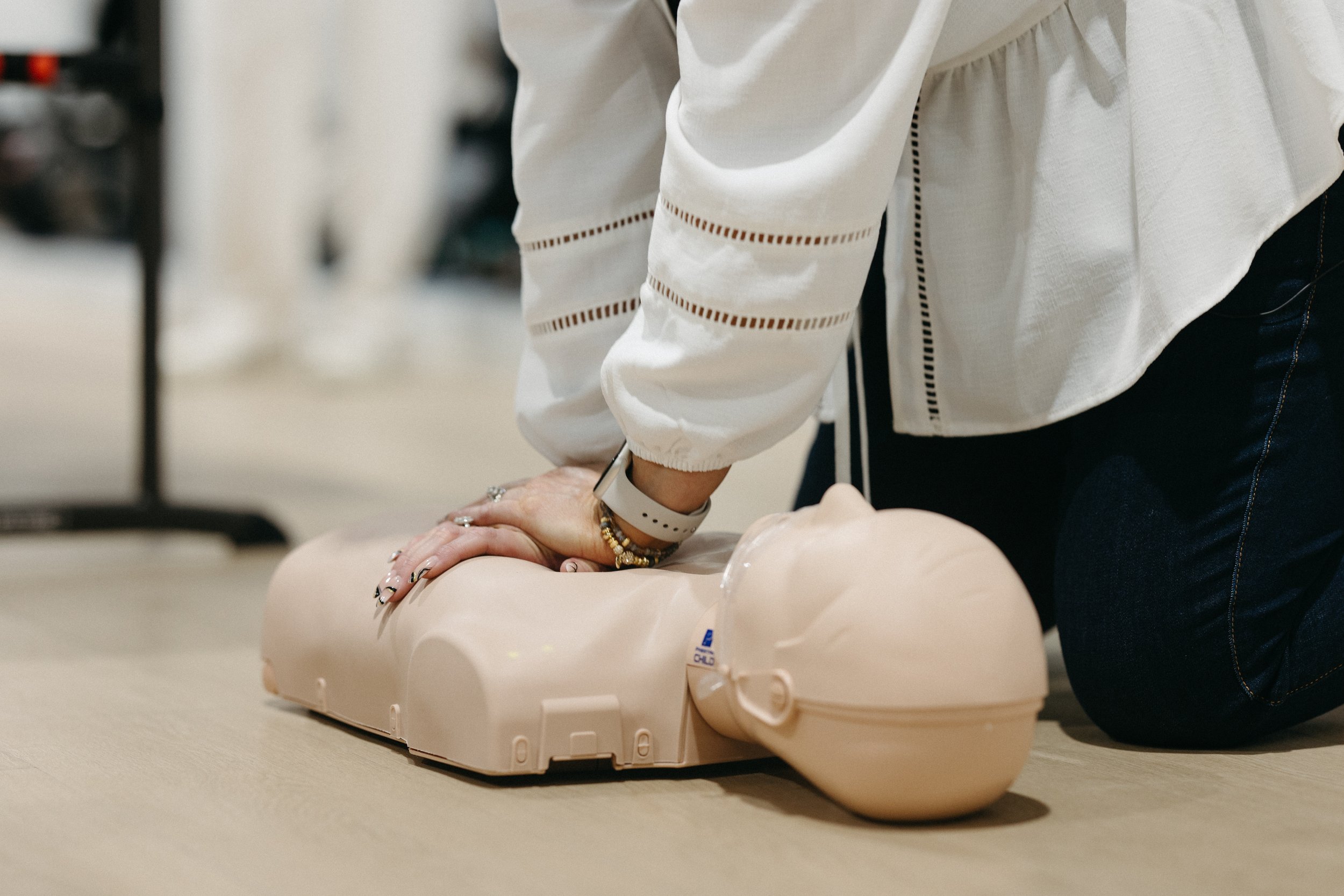
Start CPR with 30 chest compressions: heel of one hand (or two hands if you need more power) in the centre of the chest, on the lower half of the breastbone. Push about 5 cm (2 in) deep, 100 to 120 times a minute, letting the chest come all the way back up.
Open the airway and look in the mouth before giving breaths. Remove the object only if you can clearly see it and easily take it out.
Give 2 breaths, then keep going with cycles of 30 compressions and 2 breaths.
Use the AED as soon as it arrives and follow its prompts.
Keep going until your child starts showing signs of life or emergency responders take over.
Breaths matter here. When a child's heart stops because of a breathing emergency like choking, rescue breaths are an important part of CPR.
Reading the steps is a great start, but CPR really clicks once your hands have practised on a manikin.
What Not to Do When a Child Is Choking
Don't interrupt a strong cough
If your child is coughing hard, crying or talking, let them cough. Back blows or thrusts can get in the way of their own best effort to clear it.
Don't reach blindly into their mouth
Only take an object out if you can clearly see it and easily grab it. A blind finger sweep can push it further into the airway.
Don't give water or food
Don't offer a drink or a bite of bread to "wash it down." It can make things worse.
Don't wait to call 911
A child with severe choking can become unresponsive quickly. Get help on the way while they're still awake.
Don't let them leave the room
This one is a practical tip rather than an official guideline. Older children sometimes feel embarrassed and leave the room when something goes down the wrong way. Teach them that if they ever can't breathe, they stay with a grown-up and show them, so someone can help.
After the Object Comes Out
The scare isn't quite over when the object comes out.
If 911 was called, stay on the line and follow the dispatcher's instructions.
Keep watching your child's breathing, colour and alertness.
Comfort them. Big feelings and tears afterwards are completely normal, for both of you.
After any choking scare, get your child checked by a doctor, even if they seem fine. This matters most if you gave back blows or abdominal thrusts. Abdominal thrusts can cause injuries you can't see, and a small piece of the object may still be stuck.
Get medical help right away if your child has:
A cough that won't go away.
Wheezing, noisy breathing or trouble breathing.
Trouble swallowing, drooling, or chest or tummy pain.
If you think your child swallowed a button battery or a magnet, go to the emergency department right away, even if they seem completely fine.
How to Help Prevent Choking in Toddlers and Children
We can't prevent every emergency, but a few everyday habits make a real difference.
Sit down to eat
Children should sit upright for meals and snacks, ideally at a table or in a high chair. Not while walking, running, playing, lying down or riding in the car.
Stay close enough to see their face while they eat. A calm, unrushed meal goes a long way.
Prep the trickiest foods
Firm, round, smooth and sticky foods are the biggest choking risks for children under 4. Think whole grapes, hot dogs, popcorn, nuts, hard candy and raw carrots.
Some are best skipped for now, and many just need to be prepped differently. Our guide to safely serving grapes, oranges and strawberries walks through it by age and stage, and you can find more in our list of foods that may be choking hazards.
Do a quick floor sweep
Toddlers explore with their mouths. A quick check of floors, couch cushions and play areas for coins, small toy parts, hair elastics and batteries helps a lot.
A handy at-home test: if an object fits through an empty toilet paper roll, it's small enough to be a choking risk for young children. Our guide to unexpected choking hazards covers the sneaky ones, like big siblings' toys and guests' bags.
Choose foil balloons
Latex balloons and balloon pieces are a serious choking hazard for young children. Foil (Mylar) balloons are a safer choice, and pop any broken latex balloon pieces straight into the garbage.
Teach older children what to do
School-age children can learn to show the choking sign (hands at the throat), to stay with an adult if they can't breathe and to call 911. Our guide on how to talk to children about CPR and 911 has ideas for every age, without the fear.
Share These Steps With Everyone Who Cares for Your Child
Grandparents, babysitters, daycare providers and older siblings may be the ones there when it happens.
Many of them learned abdominal thrusts only, or haven't practised in years. Send them this article, or learn together so everyone knows the same current steps.
A Gentle Reminder
You don't need to be perfect in an emergency. You need a plan your brain can find when your heart is racing.
Remember:
Loud is gagging. Quiet is choking.
Call 911.
5 back blows, 5 abdominal thrusts, repeat.
Unresponsive? Start CPR.
Get checked afterwards.
Practising these steps ahead of time, on a manikin and with someone guiding you, is what turns "I think I know" into "I know what to do." You've got this.
Continue Learning
Continue building your family's safety toolkit with these trusted resources from Bump + Baby Matters.
Infant & Child CPR + Choking Classes
Infant Choking First Aid: The 5 + 5 Rule Explained
Unexpected Choking Hazards Parents Often Overlook (And How to Spot Them)
How to Safely Serve Grapes, Oranges, and Strawberries By Age and Stage
How to Talk to Kids About CPR and 911 (By Age): Building Confidence Without Fear
Have a question? We're always happy to help. Send us a message on Instagram.