
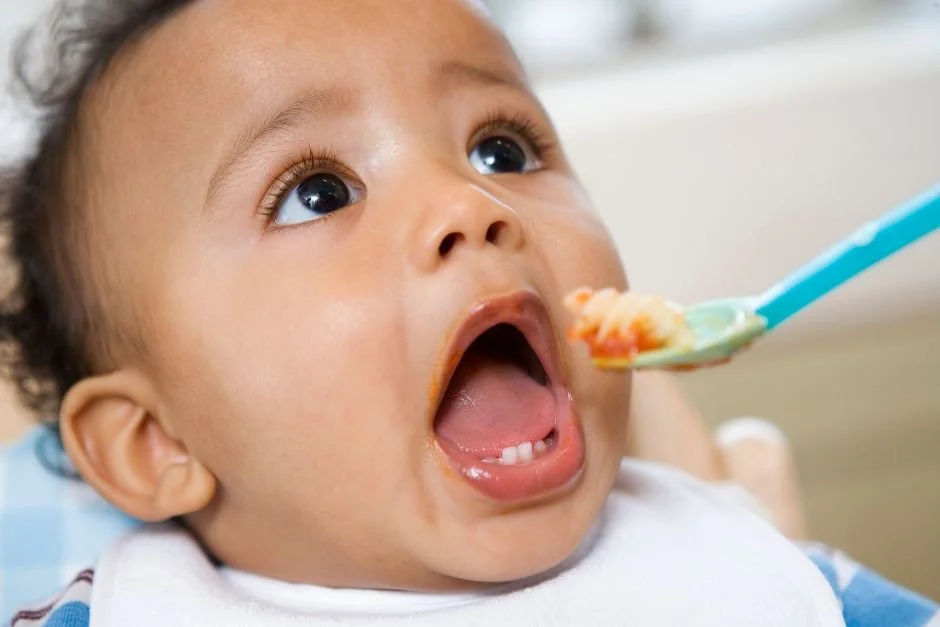
When we first start offering solid foods, it can feel as though our baby is doing everything except eating.
They may squeeze the avocado, lick the spoon, suck on a piece of toast, move food around their mouth, spit it back out, drop it on the floor, or gag before trying again.
It is natural to wonder:
Are they actually learning anything?
They are.
These early meals give babies opportunities to learn how food feels, moves, and changes inside their mouths. You may hear this process described as mouth mapping.
There is also an important safety piece to understand. Exploration does not eliminate choking risk, and not every feeding difficulty should automatically be dismissed as normal learning.
Let’s walk through what mouth mapping means, what it can look like, and how we can support it safely.
What Is Mouth Mapping?
“Mouth mapping” is not a formal medical diagnosis or a single developmental milestone.
It is a parent-friendly way to describe the sensory and movement skills babies practise as they begin managing food in their mouths.
Babies are gradually learning how to:
Feel where food is in their mouth
Recognize its size, shape, temperature, and texture
Close their lips around food or a spoon
Use their jaw to bite, munch, and eventually chew
Move food with their tongue
Shift food toward the sides of their mouth
Gather food together before swallowing
Spit out food they are not ready to swallow
Coordinate their hands, mouth, and eyes while self-feeding
These skills develop over time rather than appearing all at once.
Alberta Health Services describes a gradual progression from early up-and-down tongue and jaw movements to lateral tongue movement, biting, chewing, and increasingly independent feeding. Children do not all follow the exact same schedule, but their feeding skills generally become more coordinated with experience and development.
Why Does Food Exploration Matter?
Babies learn about food through their senses.
Before they confidently eat a new food, they may need to:
Look at it
Smell it
Touch it
Squeeze or smear it
Bring it to their lips
Lick or suck it
Place it in their mouth
Spit it out
Try it again another day
Touching a food without eating it can still help a baby become more familiar with it.
Alberta Health Services explains that sensory food exploration can help children feel more comfortable around unfamiliar foods without requiring them to taste or eat. Health Canada also describes self-feeding as an experimental process and notes that babies may initially consume very little of the finger foods they are offered.
Exploration Matters, but Nutrition Matters Too
Starting solids is not only sensory play.
At around six months, complementary foods begin helping meet a baby’s increasing nutritional needs. Health Canada recommends beginning with iron-rich foods and gradually offering a variety of nutritious foods, textures, and modified family foods.
That means we can hold two ideas at the same time:
A baby does not need to consume a large meal for an early food experience to be valuable.
We should continue offering nutritious foods regularly so eating skills and food intake can gradually develop.
What Can Mouth Mapping Look Like?
During early meals, your baby may:
Rub food between their fingers
Bring food to their lips and take it away
Lick or suck food without biting
Bite food and spit the piece back out
Move food around with their tongue
Push food forward out of their mouth
Use their fingers to remove a piece
Hold food in their cheek briefly
Open and close their jaw in a munching motion
Make faces when trying a new texture
Gag occasionally
Eat only a small amount
Repeat the same action many times
A baby spitting out a piece of food has not necessarily “failed” to eat it. They may be learning how firmly to bite, how the piece changes in their mouth, or that they are not yet ready to swallow it.
However, the overall pattern matters.
Occasional gagging or spitting while a baby develops new skills can be expected. Frequent coughing, repeated choking, breathing changes, distress with most textures, or an inability to progress may deserve further assessment.
Is Mouth Mapping Only Part of Baby-Led Weaning?
No.
Babies can develop feeding skills through:
Appropriately prepared finger foods
Mashed or lumpy foods
Preloaded spoons
Responsive spoon-feeding
A combination of self-feeding and caregiver assistance
Baby-led weaning is one way to introduce solids, but it is not the only way babies can learn to manage food.
Health Canada recommends offering finger foods to encourage self-feeding while also balancing help with independence according to the baby’s developmental abilities.
We can offer a spoon and allow our baby to reach for it.
We can preload a spoon and place it on the tray.
We can hold the spoon while waiting for our baby to lean forward and open their mouth.
What matters most is that we respond to their cues rather than pushing food into a closed or turning-away mouth.
Gagging and Choking Are Not the Same
Gagging can be startling to watch, especially during the first few weeks of starting solids.
A gag is a protective reflex that helps move food forward when a baby is not yet ready to swallow it. Babies may cough, retch, open their mouth, bring their tongue forward, spit out food, or occasionally vomit while gagging.
Alberta Health Services explains that gagging is common while babies learn about the size, shape, taste, and texture of food. It usually becomes less frequent as feeding skills develop.
Choking happens when food or another object blocks the airway.
A choking baby may:
Be unable to breathe
Be unable to cough effectively
Be unable to cry or make a sound
Appear panicked
Have changes in skin colour
Make quiet or gasping sounds if the airway is partly blocked
Choking is an emergency and requires immediate first aid and a call to 911 when the child cannot breathe, cough, or make sounds.
What Should We Do When a Baby Gags?
Stay close and watch carefully to confirm that your baby is breathing and managing the food.
Try to remain calm and give the reflex time to work.
Do not sweep your fingers blindly through your baby’s mouth. Reaching in can push food farther back and make it more difficult for them to clear.
If your baby cannot breathe, cough effectively, cry, or make sounds, respond as you would to choking and provide the first aid you have been trained to perform.
Knowing the difference between gagging and choking is helpful, but it does not replace infant choking and CPR training.
Does Gagging Mean the Food Was Safe?
Not necessarily.
A gag can happen with an appropriately prepared food while a baby is learning. It can also happen when a piece is too large to manage, the texture is not appropriate for the baby’s current skills, or too much food has been placed in the mouth.
We should still:
Prepare foods in an appropriate size and texture
Avoid common choking hazards
Seat babies upright
Keep the eating environment calm
Actively supervise every bite
Offer small amounts at a time
Gagging is a protective reflex, but it should never be treated as a substitute for safe food preparation and supervision.
How to Support Mouth Mapping Safely
1. Wait Until Your Baby Is Developmentally Ready
Most babies begin solids at around six months, but age is only one piece of readiness.
Babies should be able to maintain good head and neck control and sit upright with appropriate support. They should also show interest in food and be able to bring objects toward their mouth.
If your baby was born prematurely or has medical, developmental, feeding, or swallowing concerns, speak with their healthcare provider about readiness and any individualized feeding recommendations.
Not sure whether your little one is ready? Our starting-solids readiness guide walks through the signs to look for before that first meal.
2. Create a Stable, Upright Eating Position
Seat your baby upright in a high chair or other appropriate feeding seat.
Use the harness according to the manufacturer’s instructions, and make sure your baby is supported well enough that they are not slumping, leaning heavily to one side, or struggling to hold their head steady.
Good positioning allows babies to focus more energy on eating and managing food.
3. Actively Supervise Every Meal
Stay close enough to see your baby’s face, mouth, and breathing throughout the meal.
Active supervision means we are:
Watching rather than looking at a phone
Close enough to respond immediately
Aware of what food is on the tray
Not leaving the room, even briefly
Keeping pets from gathering beneath the chair and distracting the baby
Giving a baby room to explore should never mean turning our attention away.
4. Prepare Food for Your Baby’s Current Skills
Offer foods that are soft enough and prepared in a shape and size your baby can manage.
Avoid foods that are hard, small and round, or smooth and sticky unless they have been safely modified. Health Canada and HealthLink BC recommend matching textures to a child’s age and development and avoiding common choking hazards for young children.
A baby’s ability to pick up a piece of food does not automatically mean they can safely chew and swallow it.
Our fruit-preparation guide shows how the way we serve common fruits changes as feeding skills develop.
5. Offer a Variety of Textures
Babies need opportunities to experience more than one perfectly smooth texture.
Depending on their development, this may include:
Puréed foods
Mashed foods
Soft lumps
Tender minced foods
Soft finger foods
Preloaded spoons
Health Canada recommends offering a variety of soft textures from around six months, introducing lumpy textures no later than nine months, and progressing toward modified family foods by about one year. Children with feeding or swallowing concerns may need individualized advice.
6. Offer Small Amounts and Add More
A crowded tray can make it difficult for a new eater to focus and may encourage them to grab or stuff several pieces at once.
Begin with one or two pieces or a small spoonful.
Offer more when your baby shows interest.
This does not mean limiting how much your baby is permitted to eat. It simply makes each portion easier to manage while allowing us to follow hunger and fullness cues.
7. Eat Together When Possible
Babies learn by watching us.
Sit where your baby can see you:
Take a bite
Move your jaw
Bring food to the sides of your mouth
Sip from a cup
Pause between bites
We do not need to exaggerate every movement, but simple modelling can help babies understand what happens during a meal. Alberta Health Services recommends shared meals and showing children how to smell, touch, taste, bite, chew, and move food in the mouth.
8. Avoid Pressure
Try not to:
Push food past closed lips
Scrape food into the mouth
Hold a baby’s hands down while feeding
Distract them into taking another bite
Praise every swallow
Ask them to finish a set amount
Continue when they are repeatedly turning away or becoming distressed
Responsive feeding means offering support while allowing the child to guide whether and how much they eat. Health Canada recommends positive interaction without verbal or physical coercion.
9. Respect Your Baby’s Sensory Preferences
Some babies happily cover both hands and their entire face in yogurt.
Others become upset when food sticks to their fingers.
We can encourage exploration without forcing a baby to tolerate discomfort.
Try:
Offering a spoon or utensil
Placing only a small amount on the tray
Letting your baby watch you touch the food
Keeping a cloth nearby
Waiting for a natural pause before wiping
Cleaning them sooner if the sensation is clearly upsetting
The goal is to create opportunities, not insist that every baby become the messiest eater at the table.
10. Allow Time for Skills to Develop
Early feeding can be slow.
Babies may suck food before learning to bite it. They may bite before they can consistently move food to the sides of their mouth. They may spit out far more than they swallow.
Practice, development, and repeated exposure all play a role.
We do not need to rush them, but we also do not need to struggle alone if something does not feel right.
When Should We Ask for Feeding Support?
Speak with your baby’s healthcare provider, a registered dietitian, speech-language pathologist, occupational therapist, or qualified feeding professional if you notice:
Frequent coughing during meals
Repeated choking
Changes in breathing or skin colour while eating
Gagging multiple times during most meals
Gagging consistently on particular textures
Frequent vomiting associated with eating
Significant distress when food approaches the mouth
An inability to progress beyond very limited textures
Meals that are consistently long or exhausting
Concerns about growth, hydration, or nutritional intake
A loss of feeding skills your child previously had
Alberta Health Services recommends seeking guidance when gagging is frequent, occurs repeatedly with particular textures, or is accompanied by coughing, breathing changes, colour changes, or recurrent respiratory infections. A feeding specialist can help determine whether the concern involves coordination of mouth movements or swallowing.
Asking for support does not mean something is seriously wrong. It simply helps us understand what our child needs.
✅ Mouth Mapping and Safe Feeding Checklist
Before the meal:
✔ Make sure your baby is alert and developmentally ready.
✔ Seat them upright and secure them according to the chair’s instructions.
✔ Prepare food in an appropriate size and texture.
✔ Begin with a small amount.
✔ Remove screens and unnecessary distractions.
✔ Stay within arm’s reach.
During the meal:
✔ Let your baby touch, smell, lick, and explore.
✔ Respond to hunger and fullness cues.
✔ Avoid pushing or placing food into a resistant mouth.
✔ Watch your baby’s face and breathing.
✔ Stay calm if they gag and continue watching closely.
✔ Never perform a blind finger sweep.
After the meal:
✔ Notice patterns rather than judging one meal.
✔ Consider which textures were easier or more difficult.
✔ Remember that very little food may be swallowed during some early meals.
✔ Seek guidance if coughing, choking, distress, or difficulty progressing becomes frequent.
Want Product Suggestions?
We have gathered some of our favourite practical mealtime products for babies and toddlers in one place.
→Mealtime Essentials | Feeding Essentials for Babies & Toddlers
Products cannot replace safe food preparation or active supervision, but an appropriate high chair, easy-to-hold utensils, and washable feeding supplies can make this stage easier to manage.
Final Thoughts
Mouth mapping is a simple way to describe something quite complex: your baby is learning how food feels, where it moves, and what their lips, tongue, cheeks, and jaw need to do next.
It may look like licking, sucking, biting, spitting, squishing, gagging, or eating almost nothing at all.
Some of that exploration is expected.
Our job is not to rush the process or eliminate every messy moment. It is to create a safe, supported space where our babies can practise while we remain close, attentive, and responsive.
With appropriate food preparation, active supervision, and time to learn, those early uncertain movements gradually become more coordinated eating skills.
And remember, friends: asking for support when feeding feels difficult is part of being prepared not a sign that you have done anything wrong.
You’ve got this!
Continue Learning
Continue building your family’s safety toolkit with these trusted resources from Bump + Baby Matters.
Infant & Child CPR + Choking Classes
Is My Baby Ready for Solids? Readiness Signs, First Foods, and Safe Starting Tips
Starting Solids: How to Manage the Mess Without Limiting Learning
Introducing Allergens to Babies: When and How to Start (Canadian Guidelines for Parents)
Infant Choking First Aid: The 5 + 5 Rule Explained
Have a question? We’re always happy to help. Send us a message on Instagram.