
Originally published May 17, 2026 Last updated August 19, 2026.
Introducing new foods is an exciting milestone.
It can also bring one very understandable question:
What if my baby has an allergic reaction?
Most babies introduce common allergenic foods without having a reaction. But knowing what an allergic reaction can look like, when symptoms may be serious, and what to do next can make starting solids feel much less intimidating.
The most important thing to understand is that allergic reactions do not always follow a predictable pattern. A few hives may remain mild, or symptoms can progress. Anaphylaxis can also happen without hives.
That is why we want to know the signs, watch the whole baby rather than one symptom, and have a clear plan for when to get help.
Let's walk through it together.
⚠️ If Your Baby May Be Having a Severe Allergic Reaction Right Now
If your baby is having difficulty breathing, has swelling of the tongue or throat, becomes very pale, blue, floppy or unresponsive, or you believe they may be experiencing anaphylaxis:
If your baby has been prescribed an epinephrine device, give it immediately according to their emergency plan.
Then:
Call 911. Tell the dispatcher you suspect anaphylaxis.
Stay with your baby.
Position them safely. Do not suddenly sit them up, stand them up or carry them around upright unnecessarily.
If they are vomiting, place them on their side.
If they are having difficulty breathing, they may be more comfortable sitting.
If symptoms are not improving and a second prescribed dose of epinephrine is available, a second dose may be given as early as five minutes after the first according to their emergency plan or emergency guidance.
Your baby still needs emergency medical assessment even if they seem completely better after epinephrine.
If your baby does not have prescribed epinephrine and you suspect anaphylaxis, call 911 immediately.
Do not wait to see whether a serious reaction improves on its own.
What Can an Allergic Reaction Look Like in a Baby?
One of the challenges with babies is that they cannot tell us that their throat feels tight, their stomach hurts or they feel dizzy.
We have to watch what their body is telling us.
Allergic-reaction symptoms can involve several different body systems.
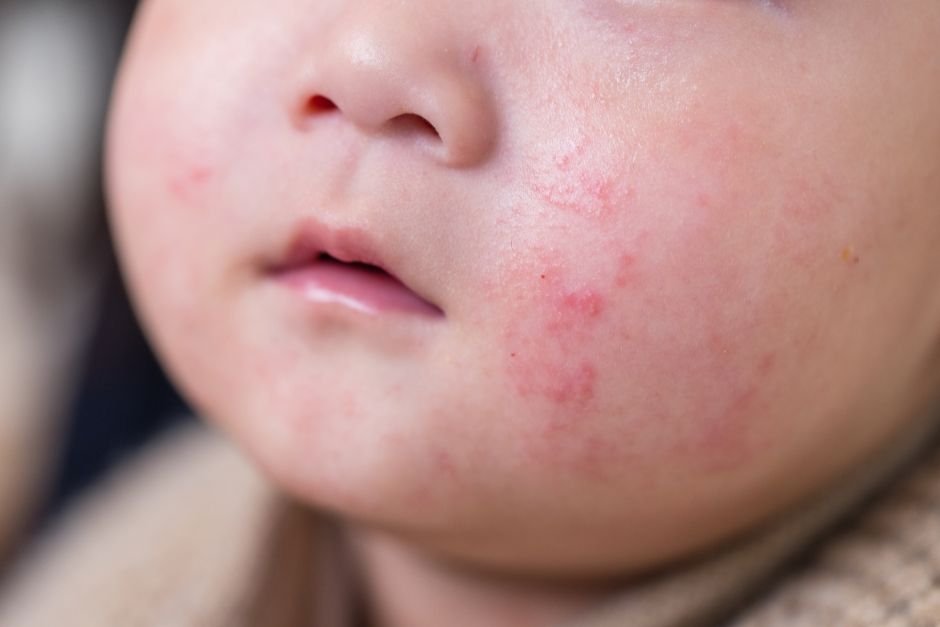
Skin symptoms
Watch for:
Hives or raised welts
Itching
Warmth or flushing
Redness
Swelling of the face, lips or tongue
A little redness exactly where a messy or acidic food has touched the skin is not always an allergic reaction. Contact irritation can happen around a baby's mouth.
Hives, obvious swelling, spreading redness or symptoms elsewhere in the body deserve more attention.
Breathing and throat symptoms
Watch for:
Coughing
Persistent coughing
Wheezing
Noisy or difficult breathing
Shortness of breath
A hoarse or changed cry or voice
Trouble swallowing
Swelling or tightness involving the throat or tongue
Breathing or throat symptoms after exposure to a suspected allergen can be signs of anaphylaxis.
Do not wait for hives to appear before responding.
Stomach symptoms
These can include:
Vomiting
Repeated vomiting
Diarrhea
Abdominal pain or cramping
A baby cannot tell us that their stomach hurts. Instead, they may suddenly become very distressed, draw their legs up, cry unusually or behave differently from normal.
One episode of spitting up or vomiting does not automatically mean your baby has a food allergy. Look at what happened, when it happened and whether there are other symptoms.
Repeated vomiting, particularly when combined with hives, swelling, coughing, breathing changes or unusual behaviour, is more concerning.
Circulation and behaviour changes
Watch for:
Skin becoming unusually pale
A blue or grey colour
Sudden weakness
Floppiness
Unusual lethargy
Becoming difficult to wake
Loss of consciousness
These are emergency symptoms.
Call 911.
How Do I Know If It Is Anaphylaxis?
Anaphylaxis is a serious allergic reaction that can progress quickly.
It commonly involves symptoms in two or more body systems, such as:
Skin + stomach:
Hives and vomiting
Skin + breathing:
Hives and persistent coughing or wheezing
Stomach + breathing:
Vomiting and difficulty breathing
But anaphylaxis does not always follow that pattern.
Severe breathing, throat or circulation symptoms can indicate anaphylaxis even without hives or another obvious symptom.
The practical takeaway is simple:
Do not wait for every symptom on a checklist to appear before getting emergency help.
If your baby's breathing, airway, colour, circulation or level of responsiveness is affected after a possible allergen exposure, treat it as an emergency.
Step 1: Stop Feeding the Suspected Food
If you notice a possible allergic reaction while your baby is eating, stop offering the food.
Remove the bowl, spoon or remaining food and stay with your baby.
Do not encourage them to “try another bite” to see whether the same thing happens.
You are not trying to confirm an allergy at home. You are gathering information and making sure your baby remains safe.
Step 2: Look at the Whole Baby
Rather than trying to decide whether one individual symptom is “mild” or “severe,” quickly look for symptoms in each body system:
Skin: hives, redness, itching, swelling
Breathing: coughing, wheezing, noisy breathing, difficulty breathing, trouble swallowing
Stomach: vomiting, diarrhea, significant discomfort
Circulation and behaviour: pale colour, floppiness, unusual lethargy, collapse or loss of consciousness
This gives you a much clearer picture than focusing on one symptom by itself.
Step 3: Decide Whether This Is an Emergency
If symptoms are isolated and mild
For example, your baby develops a few hives but is:
Breathing normally
Alert and behaving normally
Not vomiting repeatedly
Not developing significant facial or tongue swelling
Not showing symptoms in another body system
Stop the suspected food, stay with your baby and monitor them closely.
Contact your healthcare provider or provincial or territorial health advice service, such as 811 where available, for guidance.
If symptoms spread, a second body system becomes involved, or your baby develops any breathing, throat, circulation or responsiveness changes, treat the situation as an emergency.
If you suspect anaphylaxis
If your baby has their own prescribed epinephrine device, give epinephrine immediately according to their emergency plan.
Then call 911.
Epinephrine is the first-line treatment for anaphylaxis.
Do not wait for antihistamines to work before giving epinephrine when anaphylaxis is suspected.
Step 4: Position Your Baby Safely While Help Is Coming
Position matters during anaphylaxis.
After epinephrine, a person experiencing anaphylaxis is generally placed on their back with their legs raised.
With a baby, the exact position will depend on what is happening:
If your baby is breathing comfortably, keep them lying down.
If breathing is difficult, they may be more comfortable in a more upright sitting position.
If they are vomiting, position them on their side.
Most importantly, avoid sudden changes from lying to sitting or standing.
Stay with your baby and follow the 911 dispatcher's instructions while you wait for emergency medical services.
Step 5: Give a Second Dose of Epinephrine If Needed
Sometimes one dose of epinephrine is not enough.
If symptoms are not improving or are worsening, a second prescribed dose may be given as early as five minutes after the first dose, when another device is available and this is consistent with your child's emergency plan or emergency medical guidance.
This is one reason families managing a known risk of anaphylaxis may be advised to have two doses available.
Step 6: Go to the Hospital Even If Your Baby Looks Better
Epinephrine can work quickly, and seeing your baby improve is reassuring.
But emergency care is still required.
Symptoms can return after initially resolving, sometimes without another exposure to the allergen. This is called a biphasic reaction.
Anyone who receives epinephrine for anaphylaxis should be transported for medical assessment and observation, ideally by ambulance.
What About Antihistamines?
This is an important distinction.
Antihistamines may sometimes be recommended by a healthcare professional for isolated skin symptoms such as itching or hives.
But antihistamines do not stop anaphylaxis.
They do not replace epinephrine and should never delay epinephrine when anaphylaxis is suspected.
For babies in particular, speak with your healthcare provider about which medication, if any, they recommend and the appropriate dose rather than guessing during a reaction.
Can Anaphylaxis Happen Without Hives?
Yes.
This surprises many parents because hives are often what we picture when we think about an allergy.
A baby can experience anaphylaxis without developing hives or a rash.
Breathing difficulty, throat symptoms, sudden pallor, floppiness or other circulation changes can be serious even if your baby's skin looks completely normal.
Always look at the whole baby.
What If My Baby Vomits Hours After Eating?
Most immediate food-allergy reactions develop relatively soon after exposure, but not every food allergy looks the same.
There is also a type of food allergy called food protein-induced enterocolitis syndrome, or FPIES, which is seen most often in infants and young children.
FPIES can cause:
Profuse or repetitive vomiting
Pallor
Significant lethargy
Symptoms typically begin around one to four hours after eating the trigger food, and hives or breathing symptoms are usually absent.
Because repeated vomiting in a baby can have many causes, parents should not try to diagnose FPIES themselves.
If your baby develops significant repeated vomiting, becomes pale or unusually lethargic, appears very unwell or shows signs of dehydration after eating, seek prompt medical assessment.
What Should We Do After Any Suspected Food-Allergy Reaction?
Once your baby is safe, the next step is figuring out what happened.
Do not reintroduce the suspected food yet
Even if the first reaction seemed mild, do not intentionally give the food again to “double check.”
Speak with your baby's healthcare provider first.
Write down what happened
It can be surprisingly difficult to remember details later.
Record:
What your baby ate
Ingredients in the food
Approximately how much they ate
What time they ate it
When symptoms began
Which symptoms appeared
How long symptoms lasted
Any medications given
Photos of visible hives, swelling or rash if it is safe to take them
If the food came from packaging, keeping the ingredient label can also be helpful.
Contact your baby's healthcare provider
Your doctor or nurse practitioner can review what happened and determine what follow-up is appropriate.
Depending on the reaction, this may include:
Avoiding the suspected trigger temporarily
Referral to an allergist
Allergy testing when appropriate
Developing an anaphylaxis emergency plan
Prescribing epinephrine
Teaching caregivers how and when to use it
Allergy testing is not something parents need to arrange for every unusual food response. Your healthcare team can decide whether testing is appropriate based on the history.
If Your Baby Is Prescribed Epinephrine
Make sure every person who regularly cares for your baby knows:
What your baby is allergic to
Where the epinephrine is kept
How to use the specific device
When to give it
That 911 should be called after epinephrine is given
Where your baby's emergency plan is kept
Practising with a trainer device can make the steps feel much more familiar before they are ever needed.
Check expiry dates regularly and ask your healthcare provider whether your child should have two doses available.
Babysitters, grandparents, daycare providers and other caregivers should all be included in the plan.
When Should Babies Be Introduced to Common Allergens?
Current Canadian guidance recommends introducing common allergenic foods at around six months of age once a baby is developmentally ready for solids.
For babies at higher risk of developing food allergy, introduction may begin earlier than six months when developmentally ready, but not before four months.
Once an allergenic food has been tolerated, continuing to include it regularly in your baby's diet is recommended.
We have a separate Parent Safety Library guide that walks through when and how to introduce common allergens, which foods to introduce and how to make the process feel more manageable.
A Few Practical Ways to Make New-Food Days Easier
These are practical parenting strategies rather than emergency medical requirements:
Introduce a new allergen when your baby is healthy.
Choose a time when you can remain nearby and observe them.
Introduce one new allergenic food at a time so it is easier to identify a possible trigger.
Prepare the food in an age-appropriate texture that does not create an unnecessary choking hazard.
Keep previously tolerated foods in the meal.
Have your phone nearby.
Know where you would find your baby's health information if you needed it.
You do not need to hover anxiously over every bite.
The goal is simply to make it easy to notice if something unusual happens.
✅ Baby Allergic Reaction Quick-Reference Checklist
If you notice a possible reaction:
✔ Stop feeding the suspected food.
✔ Stay with your baby.
✔ Look for symptoms involving the skin, breathing, stomach, circulation and behaviour.
✔ For isolated mild symptoms, monitor closely and contact your healthcare provider or health advice service for guidance.
✔ If symptoms involve more than one body system, or your baby develops serious breathing, throat or circulation symptoms, think anaphylaxis.
✔ If your baby has prescribed epinephrine and you suspect anaphylaxis, give it immediately.
✔ Call 911 after epinephrine is given.
✔ Position your baby safely and avoid sudden sitting or standing.
✔ A second dose of prescribed epinephrine may be needed as early as five minutes later if symptoms are not improving.
✔ Your baby still needs emergency medical assessment even if symptoms improve.
✔ Do not intentionally reintroduce a suspected trigger until you have spoken with your healthcare provider.
✔ Write down what happened so you can review it with your baby's healthcare team.
Final Thoughts
Introducing new foods should not feel like waiting for something to go wrong.
Most babies tolerate common allergenic foods without a problem.
Our goal as parents and caregivers is not to memorize every possible symptom or watch every bite with anxiety.
It is to know the important signs.
Know where the line between monitoring and emergency care is.
Know that epinephrine is the first-line treatment when anaphylaxis occurs.
And know what your next step will be if your baby ever reacts.
That is what preparedness looks like.
Not expecting an emergency.
Simply knowing what to do if one happens.
You've got this!
Continue Learning
Continue building your family’s safety toolkit with these trusted resources from Bump + Baby Matters.
Infant & Child CPR + Choking Classes
Introducing Allergens to Babies: When and How to Start (Canadian Guidelines for Parents)
Is My Baby Ready for Solids? Readiness Signs, First Foods, and Safe Starting Tips
Infant Choking First Aid: The 5 + 5 Rule Explained
Have a question? We're always happy to help. Send us a message on Instagram.