
Originally published April 19, 2026. Last updated July 28, 2026.
When we think about childproofing, cabinet locks, stair gates and outlet covers often come to mind first.
Furniture and television tip-overs can be easier to overlook.
A dresser may feel heavy. A bookshelf may have stood in the same place for years. A television may seem secure on its stand.
But babies and young children interact with our homes differently than adults do.
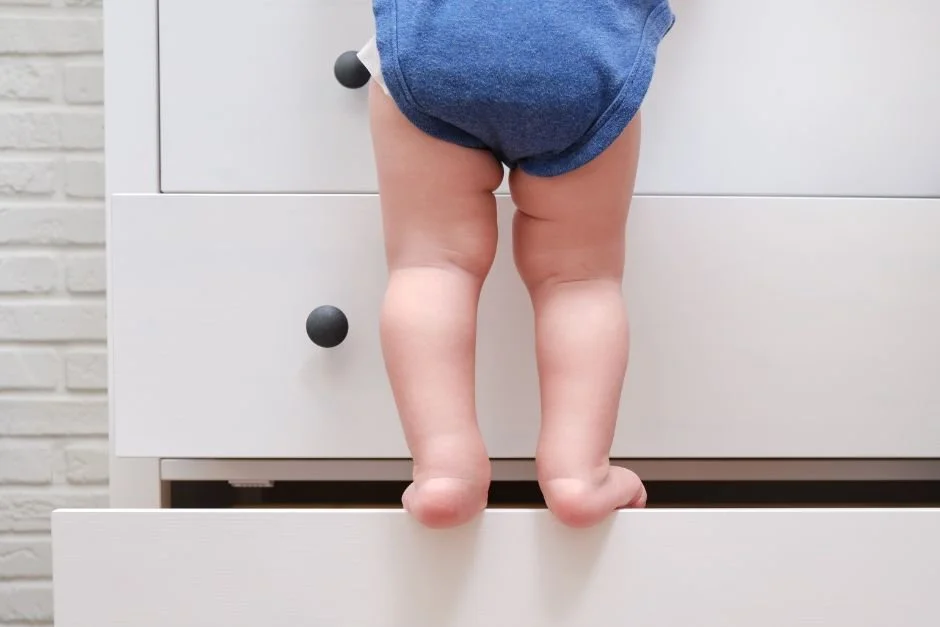
They pull on furniture to stand. They open drawers. They reach for toys, remotes and other interesting objects. As their climbing skills develop, a set of open drawers can quickly become a ladder.
Even furniture that looks stable can tip when its weight shifts forward.
The good news is that there are practical steps we can take to reduce these hazards without limiting our children’s need to move, explore and develop new skills.
Let’s walk through them together.
Why Do Furniture Tip-Overs Happen?
Health Canada’s guidance on furniture, appliance and television tip-overs explains that furniture can become unstable when:
It has a top-heavy design.
It is placed on an uneven surface.
Heavy objects are stored on top.
A child pulls themselves up on it.
A child climbs, hangs or leans on it.
One or more drawers are open.
A child sits or stands inside an open drawer.
Furniture has been assembled incorrectly or is missing hardware.
Opening drawers shifts the furniture’s weight forward.
When several drawers are open at the same time, or a child adds their body weight to one of them, a dresser that normally feels solid can become unstable.
Furniture does not need to look wobbly to present a tip-over hazard.
Anchoring Furniture Is Not About Stopping Exploration
Children are naturally curious.
They climb, reach, pull and experiment because that is how they learn what their bodies can do and how the world around them works.
Anchoring furniture is not about expecting children to sit still or never climb.
It is an example of prepared parenting: removing a serious hidden hazard so children have more freedom to explore their environment.
There is an important difference between risky play and a hazard.
Climbing an age-appropriate play structure is a challenge a child can begin to see, understand and respond to.
An unsecured dresser is different.
A young child cannot assess whether the furniture is properly assembled, attached to the wall or likely to tip when a drawer opens. That makes it an adult-managed hazard rather than a learning opportunity.
What Furniture Should Be Anchored?
Walk through every room your child can access and consider any furniture that could tip if it were climbed, pulled, pushed or opened.
This may include:
Dressers and chests of drawers
Bookshelves and freestanding shelving units
Wardrobes and armoires
Changing tables
Entertainment units and television stands
Storage cabinets and cupboards
Filing cabinets
Freestanding cubby units
Tall shoe cabinets
Display cabinets
Furniture with doors or drawers
Appliances that include manufacturer-provided anti-tip hardware
Start with furniture that is tall, top-heavy, narrow, unstable or frequently climbed.
However, do not rely on height or weight alone.
Shorter furniture may still tip when its drawers are open, and heavy furniture can cause significant injuries if it falls.
A Room-by-Room Furniture Safety Walk-Through
Tip-over hazards are not limited to nurseries.
Look at every space where your child sleeps, plays, visits or spends time.
Nursery and Children’s Bedrooms
Check:
Dressers
Changing tables
Bookcases
Wardrobes
Freestanding shelves
Toy-storage units
Televisions, if present
Anchor furniture before your baby begins pulling to stand whenever possible.
Place the crib away from furniture your child may eventually reach or use to climb. Keep cords from baby monitors, lamps, sound machines and window coverings completely out of reach.
Health Canada’s guide to setting up a safe nursery also recommends anchoring nursery furniture to a wall stud or using heavy-duty drywall anchors made for the specific type of furniture.
Living Room and Family Room
Check:
Television stands
Televisions
Media consoles
Bookshelves
Display cabinets
Sideboards
Freestanding storage units
Tall lamps or décor that could be pulled down
Pay attention to objects placed on top of furniture.
A remote control, toy, tablet, plant or decorative item may give a child a reason to climb.
Playroom
Check:
Cubby storage
Bookshelves
Toy organizers
Craft-storage cabinets
Freestanding play kitchens
Large mirrors
Storage units beside climbing toys
Low shelves can make toys more accessible, but they still need to be assessed for stability.
If a storage unit could tip when a child pulls on it, climbs it or leans against it, it should be secured according to the manufacturer’s instructions.
Kitchen and Dining Areas
Check:
Freestanding pantry cabinets
Storage cupboards
China cabinets
Bar carts
Appliances with anti-tip hardware
Shelving beside chairs, learning towers or stools
Follow the manufacturer’s installation instructions for appliances and use any anti-tip devices provided.
Remember that children may move a chair, stool or learning tower to reach something that was previously out of reach.
Home Office, Basement and Entryway
Check:
Filing cabinets
Desks with upper shelving
Bookcases
Storage cabinets
Shoe cabinets
Freestanding wardrobes
Exercise or entertainment equipment
Garage and basement shelving
These rooms may not feel like traditional play spaces, but children often explore wherever the adults in their lives are spending time.
How to Anchor Furniture Safely
There is no single installation method that works for every piece of furniture or every wall.
The safest approach depends on:
The furniture’s size, weight and construction
The anchoring kit
The manufacturer’s instructions
Whether the wall contains wood studs
Whether the wall is made from drywall, masonry or another material
Where the furniture manufacturer says the anchor should be attached
1. Begin With the Manufacturer’s Instructions
Follow the assembly and anchoring instructions provided with the furniture.
If the original instructions or anchoring kit are missing, check the manufacturer’s website or contact the manufacturer for replacement information.
Do not assume that any generic strap or bracket is appropriate for every piece of furniture.
2. Use Hardware Designed for the Furniture and Wall
Health Canada recommends securing furniture to a wall stud or using heavy-duty drywall anchors made for the specific type of furniture.
Different wall materials may require different fasteners.
When you are unsure which hardware is appropriate, ask the furniture manufacturer, hardware retailer, landlord or a qualified professional.
3. Attach the Anchor to a Structural Part of the Furniture
Follow the manufacturer’s directions for where to place the anchor.
The thin backing found on some dressers and bookshelves may not be strong enough to hold an anchoring device unless the manufacturer specifically identifies it as an attachment point.
4. Secure the Furniture Before Allowing Access
Do not assume that placing furniture against the wall is enough.
Once installed, gently check that the furniture remains stable without pulling forcefully enough to damage the hardware or wall.
5. Recheck the Installation
Anchoring is not necessarily a one-time task.
Inspect the furniture and hardware:
After furniture has been moved
After renovations or painting
If a strap, screw or bracket looks damaged
If the furniture begins shifting away from the wall
When you rearrange the room
When your child reaches a new developmental stage
During regular home-safety walk-throughs
Replace damaged or recalled hardware promptly.
Do Drawer Locks Replace Furniture Anchors?
No.
Drawer locks may prevent a child from opening drawers and using them as steps, but they do not replace proper furniture anchoring.
Use drawer locks as an added layer of protection when appropriate.
Also:
Close drawers when they are not in use.
Open only one drawer at a time.
Store heavier items in lower drawers.
Avoid allowing children to sit or stand in drawers.
Keep toys and other tempting objects off the top of furniture.
Teach children not to climb or hang from furniture.
Supervision and teaching are helpful, but they are not substitutes for securing a serious tip-over hazard.
Tip-overs can happen quickly, even when an adult is nearby.
How to Help Prevent TV Tip-Overs
Televisions require their own safety check.
Wall-Mounted Televisions
When possible, secure a flat-screen television to the wall using a mounting system designed for the television’s size and weight.
Follow the television and mounting-system instructions carefully. Consider professional installation when you are unsure about the wall structure or mounting process.
Remember that the furniture underneath a wall-mounted television may still need to be anchored.
Televisions on Stands
When a television is placed on furniture:
Use a stand designed for the television’s size and type.
Attach the television to the stand and wall when possible.
Anchor the television stand or media console.
Position the television as far back on the stand as the manufacturer recommends.
Keep remotes, toys, gaming controllers and other interesting objects away from the television.
Secure cords so children cannot pull on them.
Older televisions may be especially front-heavy.
Place them on low, stable furniture designed to support their size and weight, and attach them to the stand when possible.
Small Changes That Can Reduce Climbing Temptations
Anchoring is the most important protection against a tip-over, but a few additional changes may make climbing less appealing.
Try to:
Keep toys and favourite objects at a child-accessible level.
Remove remotes, tablets and electronics from the tops of furniture.
Keep snacks and treats away from high shelves a child can see.
Close drawers and cabinet doors after use.
Move chairs and stools away from unsecured shelving.
Secure dangling television and appliance cords.
Avoid placing a toy box or climbing toy beside tall furniture.
Create accessible storage for safe toys and books.
Children may still climb even when tempting objects are removed.
These strategies support anchoring. They do not replace it.
Buying New or Used Furniture
Before buying furniture, look for:
A wide, stable base
Furniture that sits directly on the floor
Clear assembly and safety instructions
An included anchoring kit
Drawers that allow only one drawer to open at a time
Information about replacement hardware
A design appropriate for the intended use
Furniture with narrow legs or wheels may be more likely to become unstable.
Before purchasing new or second-hand furniture, check whether the furniture or appliance has been recalled.
For used furniture, confirm that:
All parts are present.
The furniture has not been damaged.
Drawers and doors function correctly.
Assembly instructions are available.
Replacement anchoring hardware can be obtained.
The product is not subject to a recall or safety alert.
A second-hand seller may not know that a product has been recalled, so it is worth checking for yourself.
What If You Rent Your Home?
Do not assume that renting means furniture cannot be anchored.
Review your lease and ask your landlord or property manager what installation method is permitted for your walls.
Explain that the hardware is being installed to reduce a child-safety hazard. Ask for the response in writing when possible.
Depending on the home, you may need:
Permission to install wall anchors
Help locating studs
Hardware appropriate for the wall material
Installation by building maintenance or a qualified professional
A plan for repairing the wall when you move
Do not treat an adhesive product or an uninstalled portable strap as equivalent to a properly installed furniture anchor unless the manufacturer specifically confirms that it is suitable for the furniture, wall and intended use.
When furniture cannot be secured, consider moving it out of the child’s accessible space or preventing access to the room.
What About Grandparents’ Homes, Babysitters and Vacation Rentals?
Children need safer environments everywhere they spend time, not only in their primary home.
Before a visit, ask whether dressers, bookshelves, televisions and other tip-prone furniture are securely anchored.
When a hazard cannot be corrected before the visit:
Choose another room for sleep or play.
Keep doors closed or use an appropriate safety gate.
Move toys and interesting objects away from the furniture.
Keep drawers closed.
Position portable sleep spaces away from furniture and cords.
Maintain close supervision.
Supervision helps, but it should not be the only plan around unsecured furniture.
A child may climb for the first time in an unfamiliar environment where they are excited, curious or trying to reach something new.
What Should You Do If Furniture or a TV Falls on a Child?
A furniture, television or appliance tip-over may cause a crush injury, head injury, broken bone or internal injury.
This section provides general educational information and does not replace first aid training or an assessment from a qualified healthcare professional.
Call 911 Immediately If:
Your child is trapped under furniture, a television or an appliance.
They are unconscious or difficult to wake.
They are not breathing normally.
They are having difficulty breathing.
They have a seizure.
There is severe bleeding.
The object struck or is crushing their head, neck, chest or abdomen.
You suspect a serious head, neck or spine injury.
Your child’s condition appears life-threatening.
Follow the emergency dispatcher’s instructions.
If an object is preventing your child from breathing and it can be moved safely without putting you or your child at further risk, move it enough to allow breathing.
Do not attempt to lift or shift a heavy object by yourself if it may fall again or cause further injury.
If your child is not breathing normally, begin CPR and follow the instructions provided by the dispatcher.
Avoid moving your child unnecessarily when you suspect a head, neck or spine injury unless they are in immediate danger or movement is required to manage their airway.
After any significant impact, seek medical advice even if your child initially appears well. Some symptoms may develop later.
Review our guide to head injury warning signs for more information about what to watch for after a fall or impact.
A Five-Minute Home Safety Challenge
You do not need to childproof your entire home today.
Instead, choose one room and spend five minutes looking at it from your child’s perspective.
Ask yourself:
✔️ Could my child climb this?
✔️ Could this furniture tip if they pulled on it?
✔️ What would happen if several drawers were opened?
✔️ Is there anything on top that would encourage climbing?
✔️ Can my child reach or pull a cord?
✔️ Is the television secured?
✔️ Was the furniture assembled correctly?
✔️ Is it anchored according to the manufacturer’s instructions?
✔️ Has the furniture or anchoring hardware been recalled?
Choose one action you can complete next.
It might be locating the original anchoring kit, contacting the manufacturer, asking your landlord for permission or securing one dresser.
Small safety projects add up.
As Your Child Grows, So Do the Risks
Childproofing is not something we complete once and forget about.
Children develop new skills quickly.
Yesterday they were rolling.
Today they are pulling to stand.
Tomorrow they may discover that they can move a chair, open a drawer or climb higher than we expected.
Revisit your home-safety plan:
When your baby begins rolling or crawling
When they begin pulling to stand
When they start walking or climbing
When they move from a crib to a toddler bed
When furniture is moved or replaced
When you introduce a learning tower or step stool
When your child begins accessing a new area of the home
Every few months as part of a general safety walk-through
Your home does not need to be perfect.
It needs to keep changing as your child’s abilities change.
Frequently Asked Questions
Does Every Piece of Furniture Need to Be Anchored?
Assess every piece of furniture your child can access.
Prioritize anything that could tip if a child climbs, pulls, pushes, hangs from it or opens its drawers.
Tall, narrow, top-heavy and drawer-based furniture deserves particular attention, but height and weight are not the only factors.
Follow the manufacturer’s instructions and anchor any furniture identified as requiring tip-over protection.
My Furniture Feels Heavy. Isn’t That Enough?
No.
Heavy furniture can still become unstable when weight shifts forward.
Opening drawers, placing heavy items on top or adding a child’s body weight can change the furniture’s balance.
Weight alone does not prevent a tip-over.
My Child Has Never Tried to Climb. Do I Still Need to Anchor Furniture?
Yes, when the furniture could present a tip-over hazard.
Children often develop new skills before we realize they are ready to use them.
A child who has never climbed a dresser may try after seeing something interesting on top, watching another child climb or discovering that an open drawer works like a step.
Preparing before that happens is safer than waiting for the first attempt.
Can I Use Any Furniture Strap?
Use an anchoring device designed for furniture tip-over prevention and appropriate for the furniture, wall material and intended installation.
Follow the furniture and anchor manufacturers’ instructions.
When you are unsure, contact the manufacturer or ask a qualified professional.
Do Drawer Locks Mean I Do Not Need to Anchor the Dresser?
No.
Drawer locks can reduce access to the drawers, but they are an additional safety measure rather than a replacement for anchoring.
Locks can be left open, installed incorrectly, damaged or eventually figured out by a determined child.
How Often Should I Check Furniture Anchors?
Check them regularly and anytime:
Furniture is moved.
The room is rearranged.
The wall or flooring changes.
Hardware looks loose or damaged.
Your child begins climbing.
The furniture shifts away from the wall.
A recall is announced.
Include furniture anchors in your general home-safety walk-through every few months.
Can Furniture Be Anchored in a Rental?
Often, but the permitted installation method will depend on your lease, landlord and wall type.
Ask before installing hardware. When standard wall anchoring is not permitted, discuss a child-safety solution with the property owner rather than relying on an unapproved temporary product.
Key Takeaways
✔️ Furniture and television tip-overs are serious but often preventable home hazards.
✔️ Even furniture that looks stable or feels heavy can tip when a child climbs or opens drawers.
✔️ Assess furniture in every room your child can access.
✔️ Follow the manufacturer’s assembly and anchoring instructions.
✔️ Secure furniture to a wall stud or use hardware appropriate for the wall and furniture type.
✔️ Anchor television stands and secure televisions to the wall or stand when possible.
✔️ Drawer locks, supervision and teaching do not replace furniture anchoring.
✔️ Keep toys, remotes and other tempting objects away from the tops of furniture.
✔️ Check furniture and anchors regularly, especially after furniture is moved.
✔️ Revisit your safety plan as your child develops new skills.
✔️ Call 911 if a child is trapped, has difficulty breathing, is unconscious or may have a serious injury after a tip-over.
Final Thoughts
We cannot prevent every bump, fall or unexpected moment in childhood.
That is not the goal.
Our children need opportunities to move, climb, experiment and discover what their bodies can do.
Our job is to identify the hazards they cannot see or manage for themselves.
Anchoring a dresser will not stop a child from exploring.
It can help create a room where they are able to explore more safely.
Choose one room. Check one piece of furniture. Complete one safety project at a time.
That is prepared parenting. You’ve got this!
Want Product Suggestions?
Explore our Babyproofing Essentials for examples of furniture restraints, cabinet locks and other home-safety tools.
Always confirm that a product is compatible with your furniture and wall type, follow the manufacturer’s instructions and check for recalls before installation.
Continue Learning
Continue building your family’s safety toolkit with these trusted resources from Bump + Baby Matters.
Infant & Child CPR + Choking Classes
Nursery Setup for Safe Sleep: Anchoring, Cords, and Crib Placement
Am I Being a Helicopter Parent or Just a Prepared Parent?
Head Injury in Children: When to Call 911, Seek Urgent Care or Monitor at Home
Risky Play for Children: Benefits, Examples, and How to Support It Safely
Have a question? We're always happy to help. Send us a message on Instagram.